THEMIS First experimental field campaign
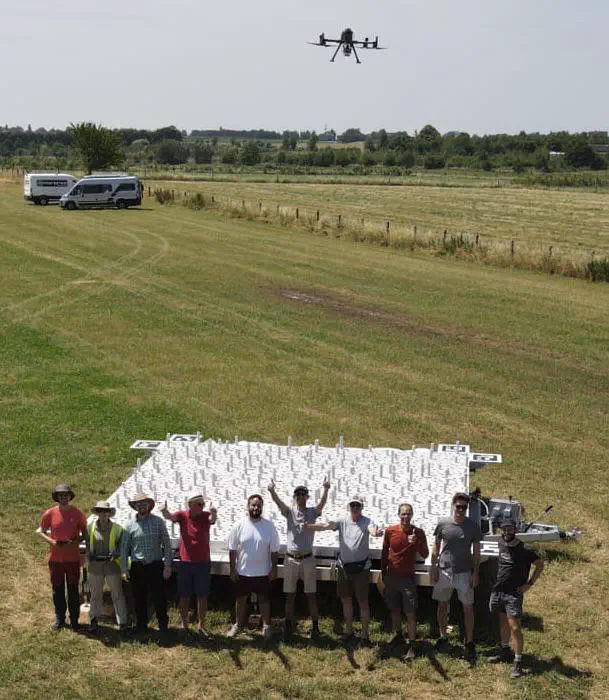
On June 23rd-25st, the first experimental field campaign using our THEMIS artificial target took place at the Centre wallon de Recherches agronomiques (CRA-W ) in Gembloux, Belgium.
The campaign was carried out as part of the Fiducial Reference Measurements for Vegetation (FRM4Veg) project, funded by the European Space Agency (ESA) and led by National Physical Laboratory (NPL). Its primary objective is to establish protocols for traceable in situ measurements of vegetation-related parameters, such as surface reflectance, in support of Earth observation satellite calibration and validation.
To support this effort, Rayference designed the 5 × 5 m THEMIS artificial target, which faithfully reproduces the angular reflectance signature of typical vegetated surfaces, including the hotspot effect. The Bidirectional Reflectance Factor (BRF) of the target coating was carefully characterised using the pab Gonio-Photometer PG2 operated by the Realistic Graphic Lab (RGL) at EPFL, while the BRF of the complete target is simulated using the Eradiate 3D radiative transfer model. Recent work has demonstrated that Eradiate can reproduce the BRF of an artificial target with an uncertainty of only a few percent (Leroy et al, 2025).
The target was manufactured by Aeriane sa, a company based in Gembloux specialising in advanced composite materials and precision mechanical engineering.
Multispectral and multi-angular drone observations were carried out by NPL under ideal cloud-free conditions.
Accurate drone measurements of vegetation surface reflectance are highly sensitive to illumination conditions, which vary with both the Sun’s position and the state of the atmosphere. Separating these effects from genuine changes in surface reflectance remains a major challenge. The aim of this collaboration is therefore to assess how accurately drone-derived surface reflectance—expressed as the Hemispherical-Directional Reflectance Factor (HDRF)—can be corrected for atmospheric effects to retrieve the Bidirectional Reflectance Factor (BRF), paving the way for more reliable and traceable Earth observation products.
We look forward to analysing the data collected during this campaign and demonstrating the potential of THEMIS to support the calibration and validation of current and future Earth observation missions.