Rayference at the 45th EARSeL Symposium in Athens
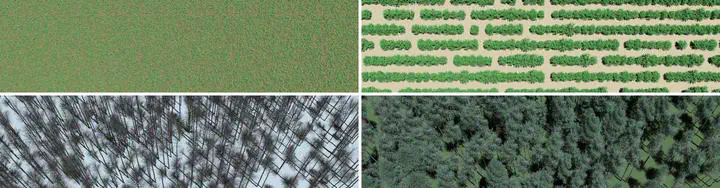 The four 3D scenes simulated with Eradiate in the study.
From 29 September to 2 October 2026, Rayference took part in the 45th EARSeL Symposium, hosted by Harokopio University in Athens (Greece).
Nicolas Misk (Rayference and Q-ForestLab, Ghent University) gave an oral presentation, Towards uncertainty characterization of anisotropic diffuse irradiance correction from field radiometry, in the session on recent developments in field, lab, airborne and spaceborne spectroscopy.
Is the sky really isotropic?
Ground-based reflectance measurements used as Fiducial Reference Measurements (FRM) for satellite validation must reach uncertainties typically below 5%. To derive the surface Bidirectional Reflectance Factor (BRF) from field radiometry, current operational methods assume that the diffuse illumination from the sky is isotropic, which greatly simplifies the atmospheric correction. But does this assumption hold over the complex 3D scenes typical of field campaigns?
To find out, Nicolas compared conventional isotropic methods with full 3D Monte Carlo radiative transfer simulations performed with Eradiate, which explicitly accounts for the anisotropy of the diffuse radiance field. The study covers four scenes of increasing structural complexity: a grass patch, a citrus orchard, and a birch forest canopy in winter and summer.
The results show that isotropy-based methods can introduce biases well beyond the 5% FRM requirement, exceeding 10% in some cases. Meeting the latest validation requirements set by the CEOS Working Group on Calibration and Validation will call for progress on several fronts: 3D radiative transfer modelling, dedicated calibration references, and additional sky radiance sensors.
This work, by N. Misk, V. Leroy, C. Emde, Y. Govaerts and M. Luffarelli, will soon be published in Frontiers. Stay tuned!
The full symposium programme is available on the EARSeL 2026 website.